Transmission across 3 regions: central, northern and southwestern; 8 gas transportation infrastructure assets; 16 compressor stations.

The following sections provide a detailed overview of the Group’s policy and commitment, governance structure, due diligence system, priority impact areas, approach to identifying and managing risks, engagement with the value chain, and mechanisms for reporting and remediation.
GEB’s Corporate Human Rights Policy, adopted in 2022, sets out the framework for building a corporate human rights culture and ensuring their respect and promotion across all engagement areas and territories where GEB and its controlled companies operate. The Policy establishes general commitments for the entire organization, as well as specific commitments with each stakeholder group.
General Commitments
Comply with national and international human rights standards, with particular emphasis on the UN Guiding Principles. Reject all forms of violence and discrimination. Apply due diligence with a preventive approach. Tolerate no retaliation. Maintain transparent engagement through grievance and request channels, as well as the Ethics Channel. Train stakeholders and contribute to universal access to energy. | With Employees
Decent, safe and respectful work: formal employment, rejection of forced and child labour, prevention of workplace and sexual harassment, equal treatment and equal pay, freedom of association and collective bargaining, work-life balance, and bias-free communication. |
With Communities
Respect for individual and collective rights, creation of development opportunities while respecting local knowledge, a diversity, equity and inclusion approach, respect for ethnic minorities and Indigenous Peoples through genuine dialogue, the right to a healthy environment, and protection for human rights defenders. | With Allies, Suppliers and Contractors
Compliance with the Policy as a contractual obligation, decent work across the value chain, adoption of good practices in human rights and diversity, equity and inclusion, and assessment of contractors’ human rights performance. |
|
|
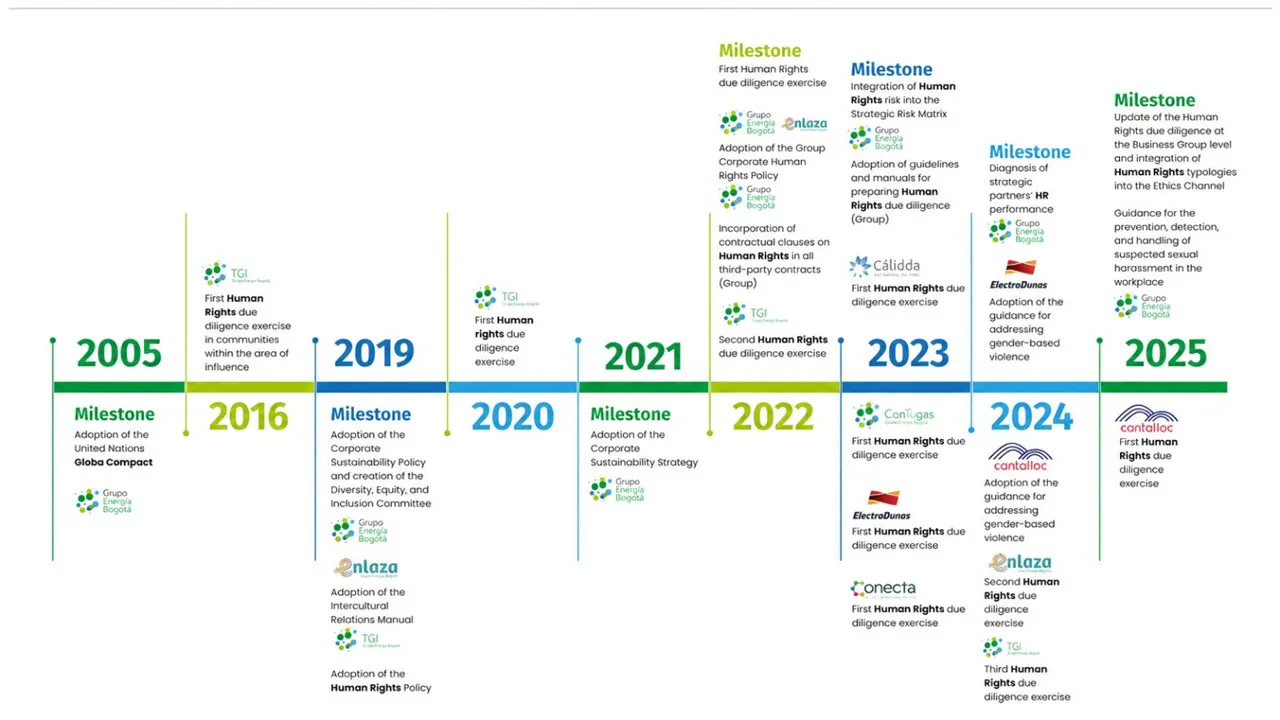
GEB’s commitment to human rights is the result of a process that evolved from targeted actions in a single subsidiary into a standardized due diligence model for the entire Business Group. The following timeline summarizes the main milestones in that evolution:
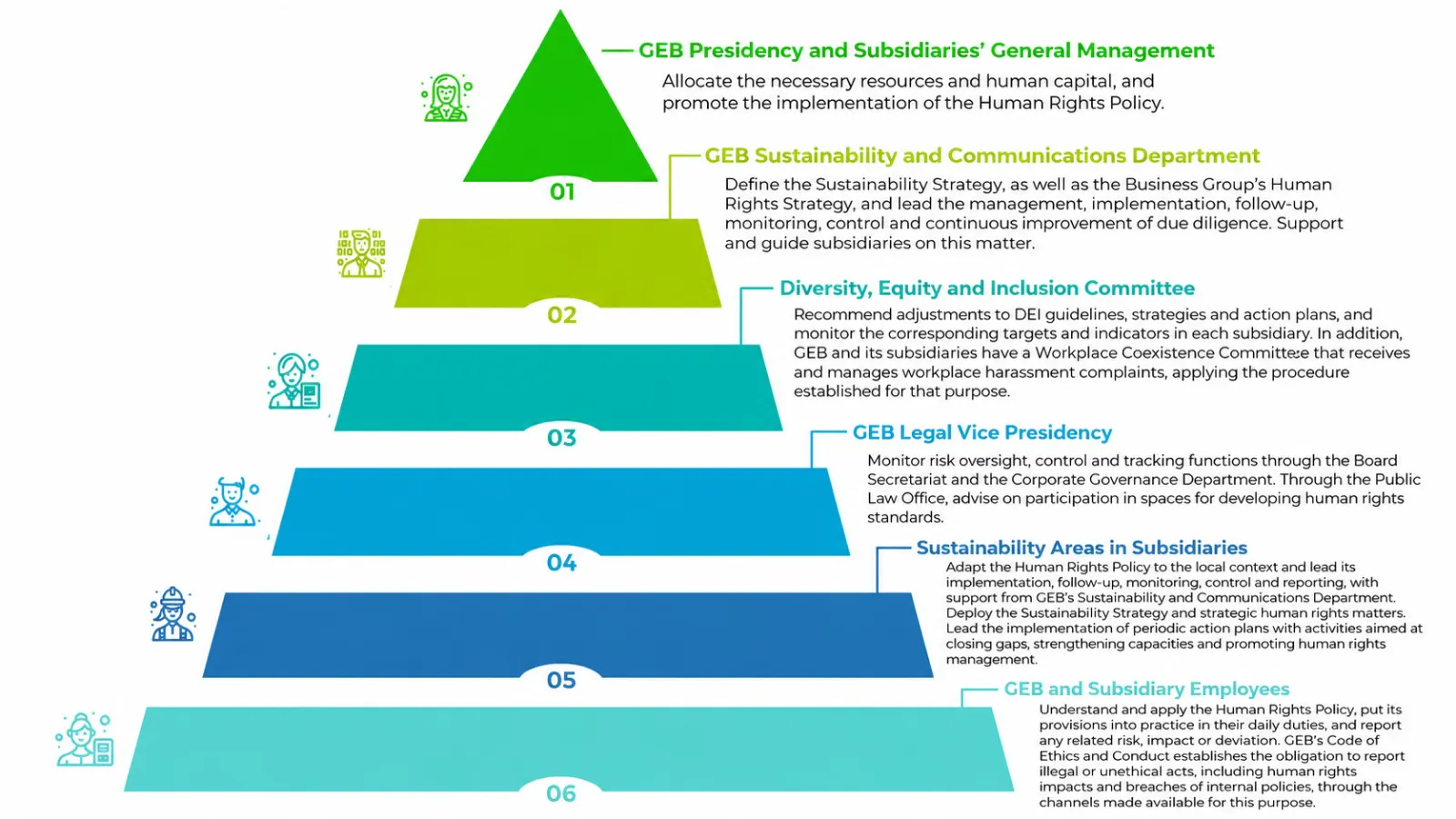
Human rights governance at GEB is structured across different levels of responsibility, from senior management to subsidiary teams and employees. This structure guides policy implementation, strengthens monitoring, and ensures that human rights due diligence is progressively embedded into the management of the Business Group.
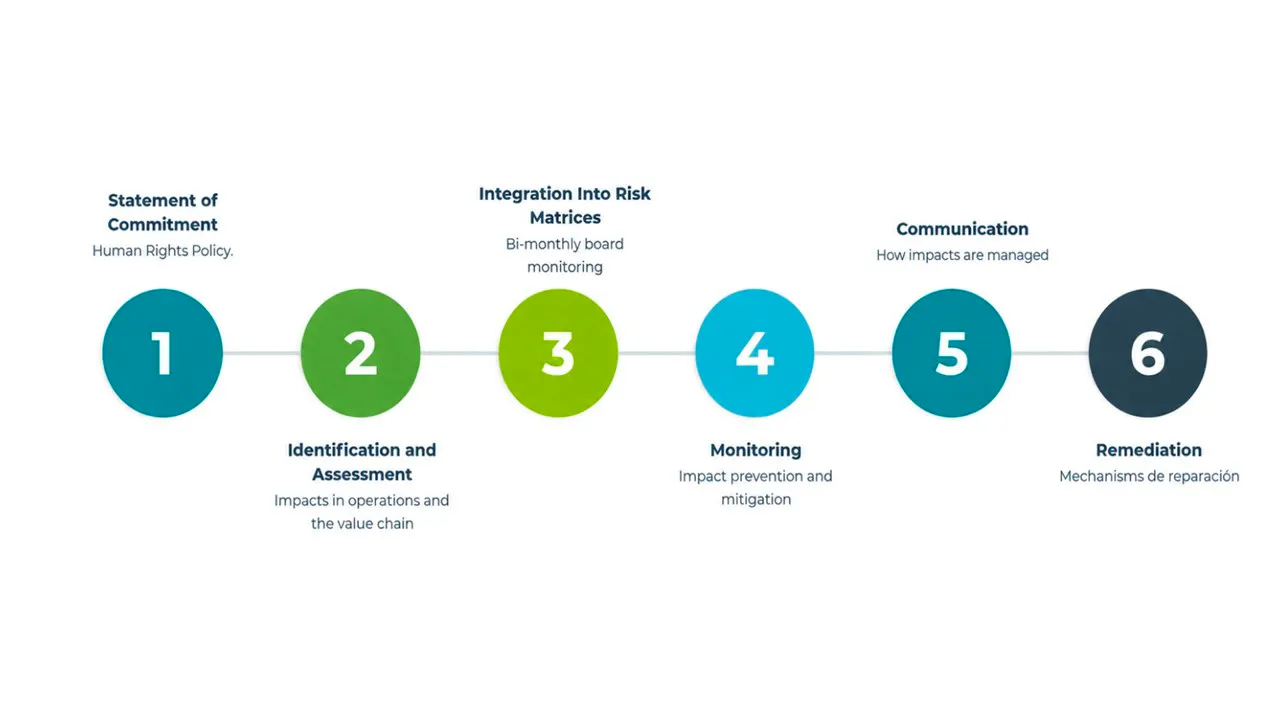
A continuous process to identify, prevent, mitigate and address actual and potential adverse human rights impacts. It covers direct employees, local communities, including women, children and Indigenous populations, as well as contractors, including third-party employees.
Transmission across 3 regions: central, northern and southwestern; 8 gas transportation infrastructure assets; 16 compressor stations.
Lima and Callao, and four additional provinces: Chincha, Pisco, Ica and Nasca.
Electric power transmission projects.
100% coverage of controlled subsidiaries and operations assessed over the last 3 years in Colombia, Peru and Guatemala.
The 8 potential human rights impact areas were identified in 2023 through GEB’s first human rights due diligence process. This assessment considered regional variables, national operating contexts, and the specific characteristics of the energy sector. The prioritization process is intended to focus management efforts on the issues with the highest potential relevance for employees, communities, contractors, suppliers, and other stakeholder groups.
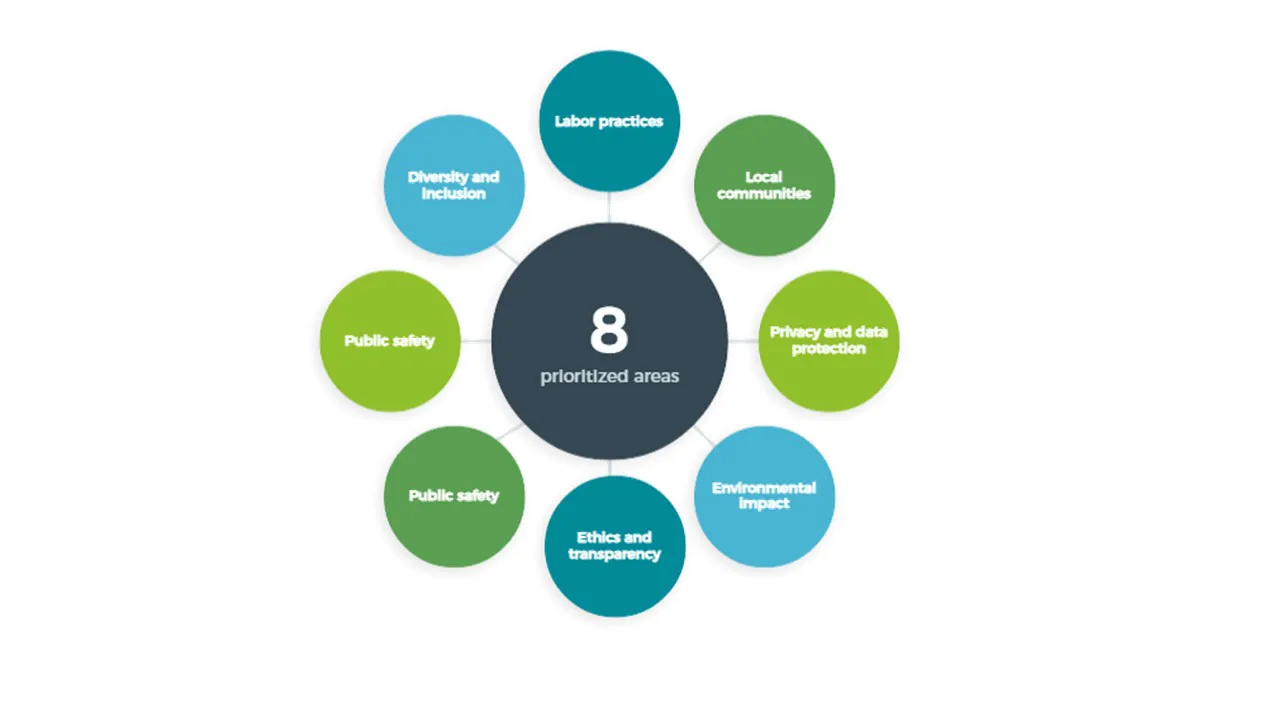
This prioritization is not static. In 2025, GEB carried out a comprehensive update of its human rights due diligence process, building on previous assessments and aligning the review with the UN Guiding Principles on Business and Human Rights. The purpose was to strengthen prevention and mitigation actions, resource allocation, and management tools. |
| In 2025, the due diligence update covered the Corporate Office and controlled subsidiaries in Colombia, Peru, and Guatemala: TGI, Enlaza, Cálidda, Contugas, ElectroDunas, Cantalloc, and Conecta. |
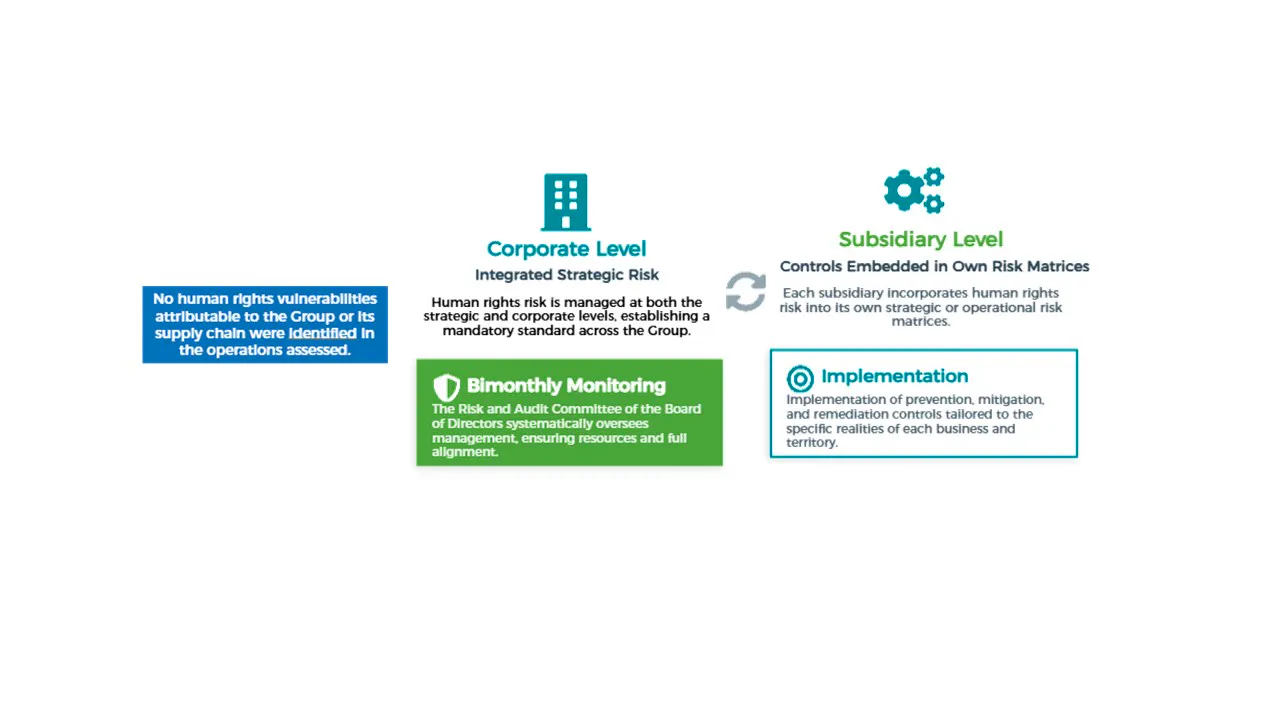
Risk management is the mechanism through which GEB translates its commitment to human rights into operational controls. Through a preventive approach, the Group continuously identifies and assesses its human rights risks in order to anticipate and manage them before they result in impacts on people.
of high-impact human rights action gaps closed at the Business Group level.
prior consultations conducted with ethnic communities.
approximate investment in the territory.
Human rights impacts are not limited to GEB’s direct operations; they may also arise or be amplified through those who provide goods, perform works, or deliver services. For this reason, the Group extends its due diligence approach across the entire value chain and promotes ethical conduct and respect for human rights in its business relationships:
| SCOPE | HUMAN RIGHTS ASSESSMENT COVERAGE OF TIER 1 CONTRACTORS AND SUPPLIERS | ||||||||||||
GEB’s value chain includes suppliers of goods and services, contractors, partners, and business associates, as well as relationships beyond the first tier, such as subcontractors and joint projects. Assurance is supported by the Code of Ethics and Conduct for Suppliers and Contractors and the Contracting and Contract Execution Control Manual, in alignment with the UN Guiding Principles on Business and Human Rights.
|
|
of security contractors of GEB, Enlaza, TGI, and Conecta received specific human rights training.
private security employees trained in human rights, totaling 223.5 training hours.
contractor employees trained in human rights, totaling 1,510 training hours.
GEB and its subsidiaries have citizen service points, physical and digital grievance channels, and the Ethics Channel. Beyond serving as complaint intake channels, these mechanisms function as listening, dialogue, and learning tools that support the early identification of risks and preventive decision-making.
Ethics Channel
Group-wide mechanism managed by an independent third party. It provides multichannel access through telephone, email, website, and mobile application, with accessibility options and a specific typology to classify and follow up on human rights-related cases.
| IN 2025, GEB’S GRIEVANCE AND REMEDIATION MECHANISMS WERE ASSESSED AGAINST THE EFFECTIVENESS CRITERIA OF THE UN GUIDING PRINCIPLES | |
|---|---|
|
|
|
|
Over the past three years, GEB has implemented human rights mitigation plans and has not identified significant violations within its operations. Should adverse impacts be identified, the Group will activate remediation measures through the mechanisms already in place.
| MITIGATION PLANS | REMEDIATION PLANS | |
|---|---|---|
| The intercultural engagement guidelines require human rights due diligence to include an assessment of actual and potential human rights impacts, as well as management measures for the different stages of the project. | When a person considers that their rights have been affected, they may use the established channels. Prevention, mitigation, and remediation measures are adopted with a differentiated approach and reasonable support from the Group, where appropriate. Potential corrective actions:
The Ethics Channel, managed by an independent third party, enables confidential reporting and proactive management of human rights-related concerns. |
| Suppliers and contractors are periodically assessed on HSE, environmental management, and social responsibility criteria. When risks are identified, improvement plans are required. | |
| Subsidiaries have Diversity, Equity, and Inclusion committees that monitor prevention and mitigation plans, including training, awareness-raising, and tools to ensure impartiality and non-discrimination. A Labor Relations Committee is also in place to manage workplace harassment complaints. | |
Is te process that organizations should carry out identify, prevent, mitigate and account how they address acyual and potencial adverse human rights impacts in their own operations, their supply chain and other relationships